

Bulletproof Your Golf Game: A Smarter Way to Prevent Golf Injuries

By Dr. Chris Ju, PT, DPT, FAFS, CSCS, USAW
How Applied Functional Science and the Functional Golf System prepare your body for every swing — from the first tee to the 18th green.
Golf looks gentle. There is no tackling, no sprinting, no jumping. Yet ask any group of regular golfers and you will hear the same stories: aching low backs, sore lead hips, golfer’s elbow, stiff necks. The golf swing is one of the most demanding rotational movements in all of sport — the body coils, uncoils, and decelerates in well under two seconds, swing after swing, round after round. Most golf injuries are not bad luck. They happen when the swing asks the body for motion and control it simply does not have, and some other body part is forced to pick up the slack. The good news: that is a problem you can train your way out of.
Why Golfers Really Get Hurt: It’s the Chain, Not the Link
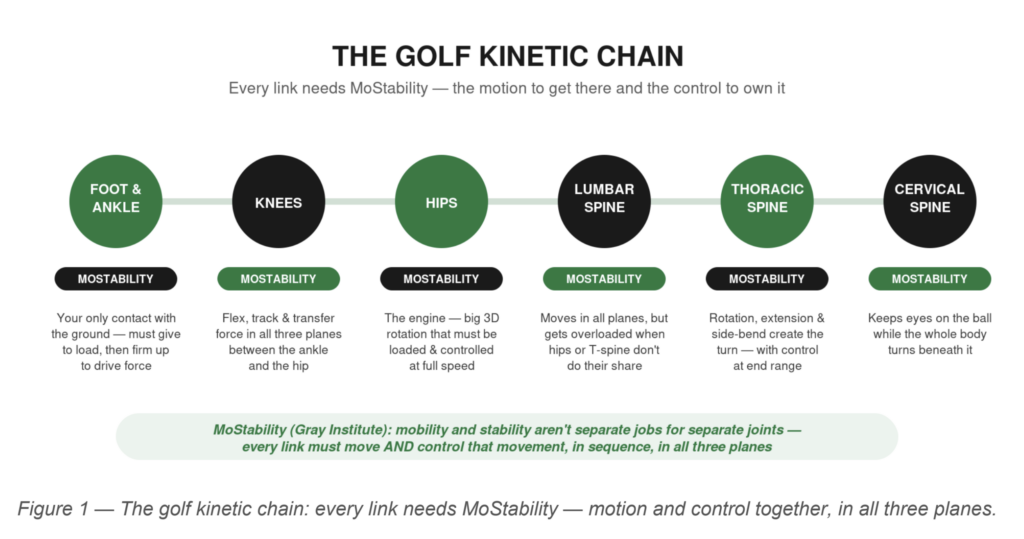
Your swing does not start in your arms. It starts at the only part of you touching the ground — your feet— and travels link by link up through the ankles, knees, hips, spine, and shoulders before it ever reaches the club. Applied Functional Science (AFS), developed by the Gray Institute, calls this a Chain Reaction: every joint depends on the joints above and below it, and the whole chain has to work in the right sequence, at the right time, in all three planes of motion.
Here is the part most golfers never hear: it is not enough for a joint to be flexible, and it is not enough for a joint to be strong. Every link in the chain needs both at the same time — enough motion to reach the positions the swing demands, and enough control to own that motion at full speed.
The Gray Institute calls this MoStability: mobility and stability working together at every joint, in all three planes of motion. A hip that can turn but cannot control the turn is just as risky as a hip that cannot turn at all. And when any link loses either ingredient, the body does not cancel the swing — it borrows from the neighbors. Hips and a mid-back that have lost motion or control are the classic recipe for golfer’s low back pain: the lumbar spine is forced to produce rotation it was never meant to handle on its own.
Three Positions Your Body Has to Own
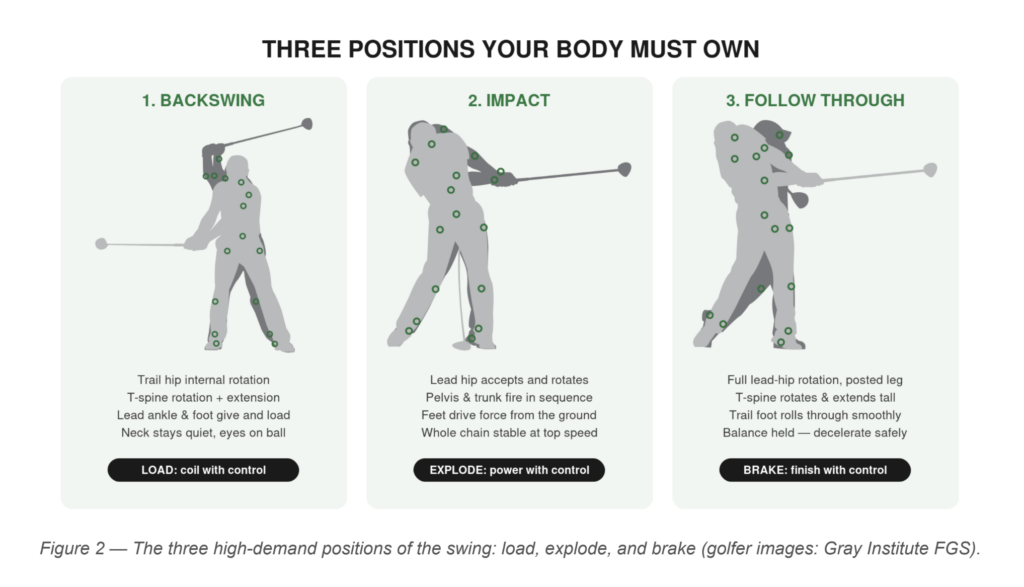
The Functional Golf System (FGS) — the Gray Institute’s application of AFS to golf — breaks the swing down into the fundamental positions your body must be able to reach and control: address, backswing, impact, and follow-through. Three of these deserve special attention, because they are where the physical demands peak.
The backswing is a loading position. Your trail hip has to rotate internally, your thoracic spine has to turn and extend, your lead foot and ankle have to give, and your neck has to stay quiet so your eyes stay on the ball while your shoulders turn roughly ninety degrees beneath your chin. Golfers who lack any one of these motions compensate — usually by swaying, standing up out of posture, or over-twisting the low back.
Impact is a position of explosive stability. In a fraction of a second your weight shifts toward the target, your lead hip accepts the load and rotates, and your pelvis and trunk must separate and fire in the correct sequence while your feet drive force out of the ground. This is where strength and stability matter most — not the ability to lift a heavy weight slowly, but the ability to control your joints at full speed.
The follow-through is the body’s braking system. Your lead hip finishes its rotation over a posted leg, your mid-back rotates and extends to a full finish, and your trail foot rolls through. Every bit of speed you created has to be decelerated somewhere; a body that cannot finish in balance sends those braking forces into the low back, lead knee, and shoulders.
Transformation Zones: Where the Swing Lives — and Where It Bites
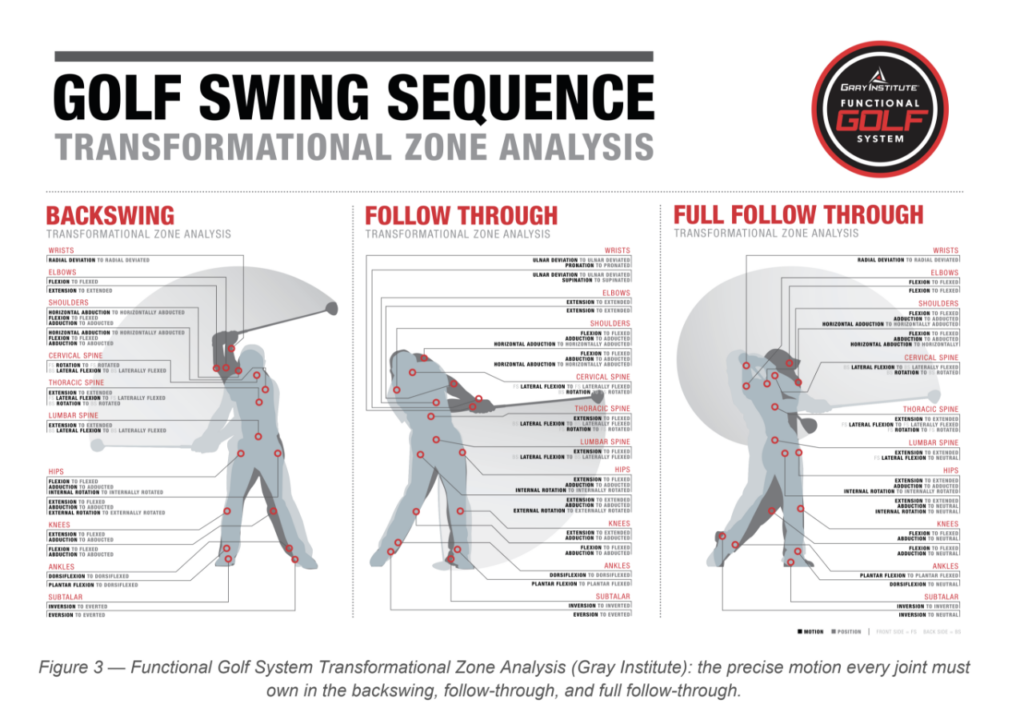
In AFS language, the end ranges of these positions are called Transformational Zones — the moments where movement in one direction is transformed into movement in the opposite direction.
The top of the backswing and the full follow-through are the swing’s great transformation zones, and they are precisely where tissue gets injured, because joints are at their end range while forces are still high. The FGS maps these zones joint by joint — subtalar joint, ankle, knee, hip, lumbar, thoracic and cervical spine, shoulders, elbows, and wrists — so training can target the exact motion each joint needs in the exact position the swing demands it.
Positions First, Then the Full Swing
This is the methodology that matters: own the positions first, then blend them into the full swing.
First, restore the mobility and flexibility each position demands — for example, trail-hip internal rotation and thoracic rotation for the backswing. Next, build strength and stability in those same positions, so you can not only get there but control and load there. Only then is the full swing trained as a whole, weaving the positions together so the joints fire in the proper coordination and sequence at game speed. In the FGS, assessment and training are the same movements — “the test is the exercise” —so every session is both a check-up and a workout.
Nothing is more frustrating than knowing exactly what you need to do technically — your teaching pro has told you, the video confirms it — but your body simply will not let you get into the position. That is not a swing flaw; it is a movement limitation, and no amount of range balls will fix it. The lesson works when the body can do what the lesson asks.
Get Assessed by Someone Who Speaks Golf
Not every well-meaning fitness program understands golf. Generic stretching and gym routines train muscles in isolation, often in one plane, in positions that have nothing to do with your swing. Work with a golf movement expert who understands the specific flexibility, mobility, strength, and stability demands of the golf swing — someone who can assess where your chain is breaking down, in which plane, and in which position, and then prescribe movements that look and feel like golf. That is the difference between exercising and preparing.
Never Skip the Functional Warm-Up
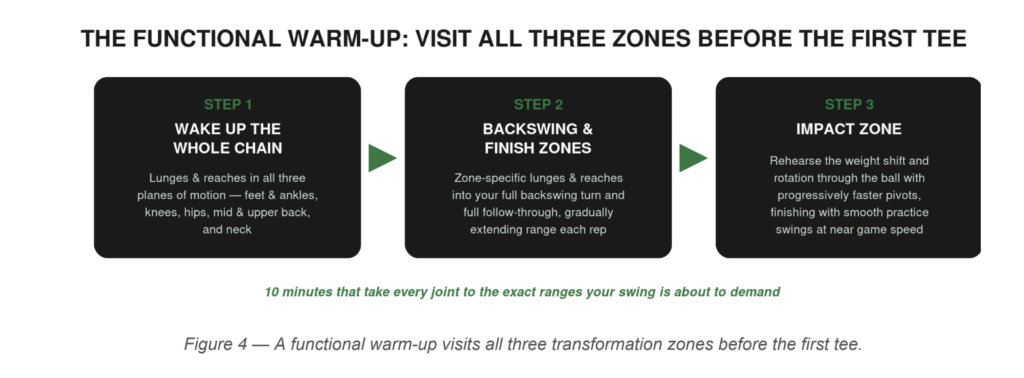
Finally, do not give the most important ten minutes of your round away. Watch the first tee at any course and you will see golfers take two practice swings and hit the longest, fastest swing of their day with a cold body. A great functional warm-up does more than raise your heart rate — it systematically wakes up every link in the chain: the feet and ankles, the knees, the hips, the mid and upper back, and the neck. The tools are functional lunges and reaches in all three planes of motion — forward and back, side to side, and rotational — and they are not generic stretches. Each lunge and reach is specific to the transformational zones of the swing, taking your joints progressively into the very backswing, impact, and follow-through ranges you are about to demand of them at full speed. Your first drive should be your eleventh swing of the day, not your first.
Want the exact routine? Click here to sign up and we’ll send you the 3D MAPS
The Bottom Line
Golf asks more of your body than it gets credit for — incredible mobility, incredible stability, and split-second coordination in every joint from the ground up.
Train those demands the way the swing actually creates them, in the positions where they actually occur, and you do not just prevent injuries.
You unlock the swing your lessons have been trying to give you all along.
Ready to build a swing your body can keep up with? The AthletIQ Golf Program pairs you with golf movement experts who can train your body for the exact demands of your swing.